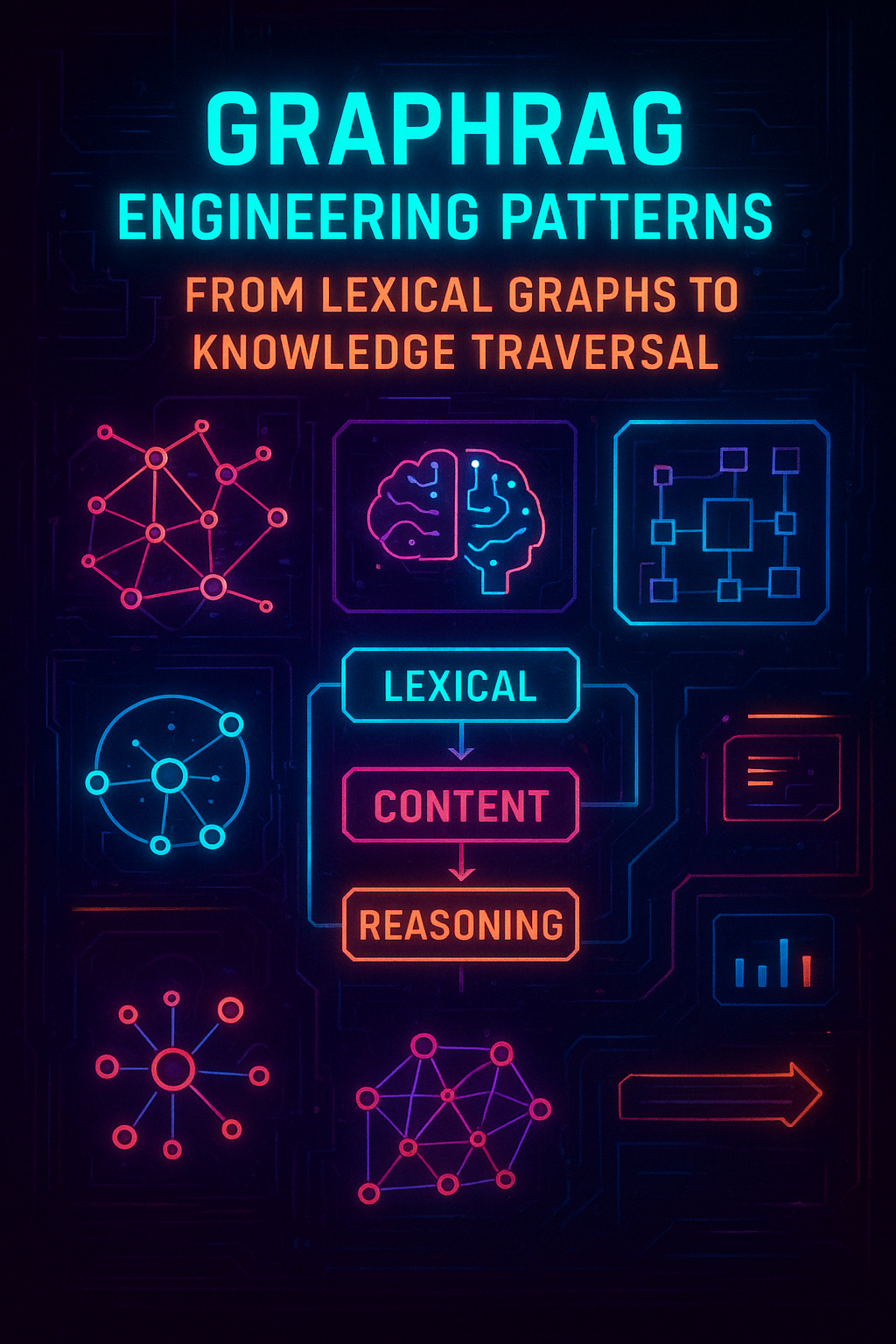
GraphRAG Engineering Patterns: From Lexical Graphs to Knowledge Traversal

Table of Contents
1. The Limits of RAG
2. Why GraphRAG Emerged
3. The Layered Anatomy of GraphRAG
3.1. Lexical Graphs: Structuring the Language Layer
3.2. Content Graphs: Connecting Meaning and Context
3.3. Reasoning Paths: From Links to Logic
4. Engineering Patterns for GraphRAG Systems
4.1 Hybrid Indexing.
4.2 Entity Anchoring.
4.3 Context Chaining.
4.4 Feedback Propagation.
5. Managing Context Windows Through Traversal
6. Enterprise Implications and the Path Ahead
1. The Limits of RAG
Retrieval-Augmented Generation (RAG) emerged as a clever workaround to one of the great weaknesses of large language models (LLMs): their lack of grounding in factual data. By combining generative capabilities with external retrieval, RAG promised a balance between creativity and correctness. It allowed systems to “look up before they make up,” pulling semantically similar passages from a knowledge base and weaving them into coherent answers.
As enterprises adopted RAG, its architectural limits became increasingly visible. What began as a promising integration of search and generation has proven fragile in the face of operational complexity, regulatory demands, and the need for reproducibility.
At its core, RAG remains probabilistic. The retrieval process, driven by vector similarity, often selects content that is semantically adjacent but factually irrelevant. The result is context without certainty. This probabilistic recall amplifies another issue, or feature by design, as hallucination, where language models fill in logical gaps with plausible but incorrect information.
The reasoning pipeline itself is opaque. Once text is retrieved, it disappears into the black box of the LLM, leaving no traceable path from input to conclusion. The system cannot explain why a particular piece of evidence was chosen or how it shaped the answer. For academic tests, this may be an inconvenience. For enterprises, it’s a critical failure.
Without clear provenance, there is no accountability. Without reproducibility, there is no trust. As a result, traditional RAG architectures struggle to meet the standards required for enterprise adoption: explainability, compliance, and auditability.
RAG solved the what of information retrieval but neglected the how of reasoning. It provided access to data but not an understanding of logic. The next evolution, therefore, must bridge this gap by transforming retrieval from a probabilistic act into a structured reasoning process. That evolution is GraphRAG.
2. Why GraphRAG Emerged
GraphRAG represents the next stage in the evolution of retrieval-based reasoning. It replaces probabilistic recall with structural reasoning, building a fact-driven foundation where every answer can be traced, replayed, and audited.
Instead of treating a corpus as an undifferentiated vector space, GraphRAG constructs explicit knowledge graphs, networks of entities, relationships, and contextual meanings. Retrieval becomes graph traversal. Each step along the reasoning path can be constrained by rules, weighted by relevance, or inspected for provenance.
This architectural clarity offers concrete benefits:
Replicability: The same query over the same graph yields identical reasoning paths.
Auditability: Every fact contributing to an answer can be traced to its source.
LLM independence: The model interprets structured evidence rather than improvising from raw text.
In short, GraphRAG transforms RAG from a statistical shortcut into an engineering discipline, designed for reliability, explainability, and enterprise trust.
3. The Layered Anatomy of GraphRAG
GraphRAG systems typically evolve from Applied Knowledge Graphs (AKGs) domain-specific models built to serve operational goals such as recommendation, document enrichment, or question answering. These AKGs converge into what can be called a Domain Graph: a unified structure combining linguistic, semantic, and procedural layers that together form the substrate of reasoning.
3.1. Lexical Graphs: Structuring the Language Layer
The lexical layer grounds language in structure. It links words, n-grams, and embeddings to conceptual nodes, providing a bridge from unstructured text to graph semantics.
Edges may represent co-occurrence, synonymy, or embedding similarity. This allows systems to navigate linguistic space with precision, retrieving not just “similar” words but semantically coherent ones.
3.2. Content Graphs: Connecting Meaning and Context
The content layer organises extracted entities, topics, and contextual links across documents. Each node represents a unit of meaning, as an entity, event, or claim, while edges encode relationships such as supports, mentions, or contradicts. Traversing this layer allows the system to surface coherent narratives rather than disjointed text chunks, enabling contextual continuity across related materials.
3.3. Reasoning Paths: From Links to Logic
Reasoning paths define how the system traverses knowledge in response to a query. They introduce procedural intelligence, deciding which edges to follow, how deep to explore, and how to aggregate meaning. By combining structural constraints with dynamic feedback (e.g., reinforcement signals from LLM outputs), reasoning paths transform static graphs into adaptive reasoning engines.
4. Engineering Patterns for GraphRAG Systems
Through experimentation and deployment, several engineering patterns have emerged as foundational to effective GraphRAG design. These patterns define how information flows between linguistic, semantic, and operational layers, transforming retrieval pipelines into structured reasoning systems.
4.1 Hybrid Indexing.
At the foundation of GraphRAG is the combination of lexical and graph-native retrieval. Vector embeddings enable semantic similarity search, while property graph traversal enforces contextual relevance and structural constraints. In practice, a hybrid index links unstructured embeddings to graph nodes, enabling two-step retrieval, first identifying candidate entities via semantic proximity, then refining them through topological reasoning. This pattern bridges the speed of vector search with the precision of graph queries.
4.2 Entity Anchoring.
A recurring challenge in enterprise-grade systems is maintaining the link between model output and its textual or factual source. Entity anchoring addresses this by maintaining explicit provenance edges between lexical tokens, extracted entities, and content segments. This ensures verifiable traceability, a crucial requirement for auditing and regulatory compliance. Each node in the graph thus carries not only meaning but also origin, timestamp, and transformation lineage.
4.3 Context Chaining.
Reasoning rarely ends within a single context window. Context chaining preserves semantic continuity across multi-hop reasoning paths, allowing the system to summarise intermediate hops and reuse them as compact context nodes. This creates a layered reasoning flow: each traversal hop contributes a higher-order summary node, turning the reasoning process into a graph of condensed meaning rather than a linear token stream. The result is both greater interpretability and reduced LLM dependency.
4.4 Feedback Propagation.
In a GraphRAG system, the graph doesn’t stay static, it learns from experience. Every time an answer is generated, user feedback or validation results can feed back into the graph, fine-tuning how relationships and relevance are weighted. For example, if a reasoning path consistently produces correct results, its connections become stronger. If it leads to errors, the system learns to avoid it. This turns the graph into a living memory that improves with use, aligning retrieval and reasoning with real-world outcomes.
In practice, this feedback loop is already emerging in applied systems like GraphDB-based QA assistants, where user corrections or LLM self-evaluation signals update relationship strengths and inference patterns. Over time, such systems evolve from static retrieval engines into adaptive reasoning networks that don’t just store knowledge but continuously refine how it’s understood and applied.
5. Managing Context Windows Through Traversal
One of the core engineering challenges in GraphRAG is context management. Where classic RAG systems concatenate retrieved text chunks into a fixed-size input, GraphRAG performs contextual condensation by extracting only the subgraph relevant to a query and summarising it into a reasoning context.
This approach changes the LLM’s role from text consumer to structured interpreter. Traversal logic determines what the model sees and how it reasons.
Key benefits include:
Efficiency: Reduced token load and lower latency.
Precision: The model sees semantically dense, non-redundant inputs.
Accountability: Each context fragment maps back to explicit nodes and relationships in the graph.
By retaining traversal memory, GraphRAG also supports incremental reasoning by reusing and expanding prior subgraphs over multi-turn conversations. This not only enhances factual continuity but also aligns with enterprise expectations for explainable, cost-efficient systems.
6. Enterprise Implications and the Path Ahead
The shift from RAG to GraphRAG is not merely a technical refinement, it represents a governance transformation. As enterprises adopt AI at scale, they increasingly demand systems that are reproducible, explainable, and auditable. These are not optional properties; they are foundational to trust in AI-driven decision-making.
GraphRAG directly addresses this requirement by embedding reasoning capabilities into the data architecture itself, rather than delegating all cognitive work to the language model. It draws on the structure of the Applied Knowledge Graph (AKG), a framework that aligns linguistic, content, and operational layers into a coherent reasoning substrate.
AKGs provide the structural backbone for GraphRAG.
Lexical graphs support interpretability by mapping linguistic elements and their contextual variants.
Content graphs enable reproducibility by capturing factual relationships and maintaining a stable semantic baseline.
Operational graphs enforce governance by making reasoning paths and inferences first-class, inspectable objects.
In operational terms, this means:
Every reasoning step can be traced through the graph, linking an answer back to the underlying sources and relationships.
Each inference path can be verified against domain logic, making model decisions transparent and debuggable.
Generated answers can be grounded in explicit factual lineage, reducing hallucinations and ensuring compliance with enterprise standards.
This architecture redefines the trust boundary between humans and AI. The LLM becomes a participant in reasoning by interpreting evidence, summarising insights, and engaging with structured knowledge rather than a speculative storyteller operating in isolation.
For enterprises, GraphRAG represents a convergence of data engineering, knowledge management, and AI governance. It turns retrieval systems into reasoning systems, and reasoning systems into accountable, verifiable knowledge platforms.
Ultimately, GraphRAG is not just a retrieval enhancement, it is a structural paradigm for the next generation of enterprise intelligence. By integrating retrieval, representation and reasoning into a single, Applied Knowledge Graph-based architectural continuum, we are moving closer to the long-standing goal of AI engineering: building systems that reason with knowledge, not just about it.