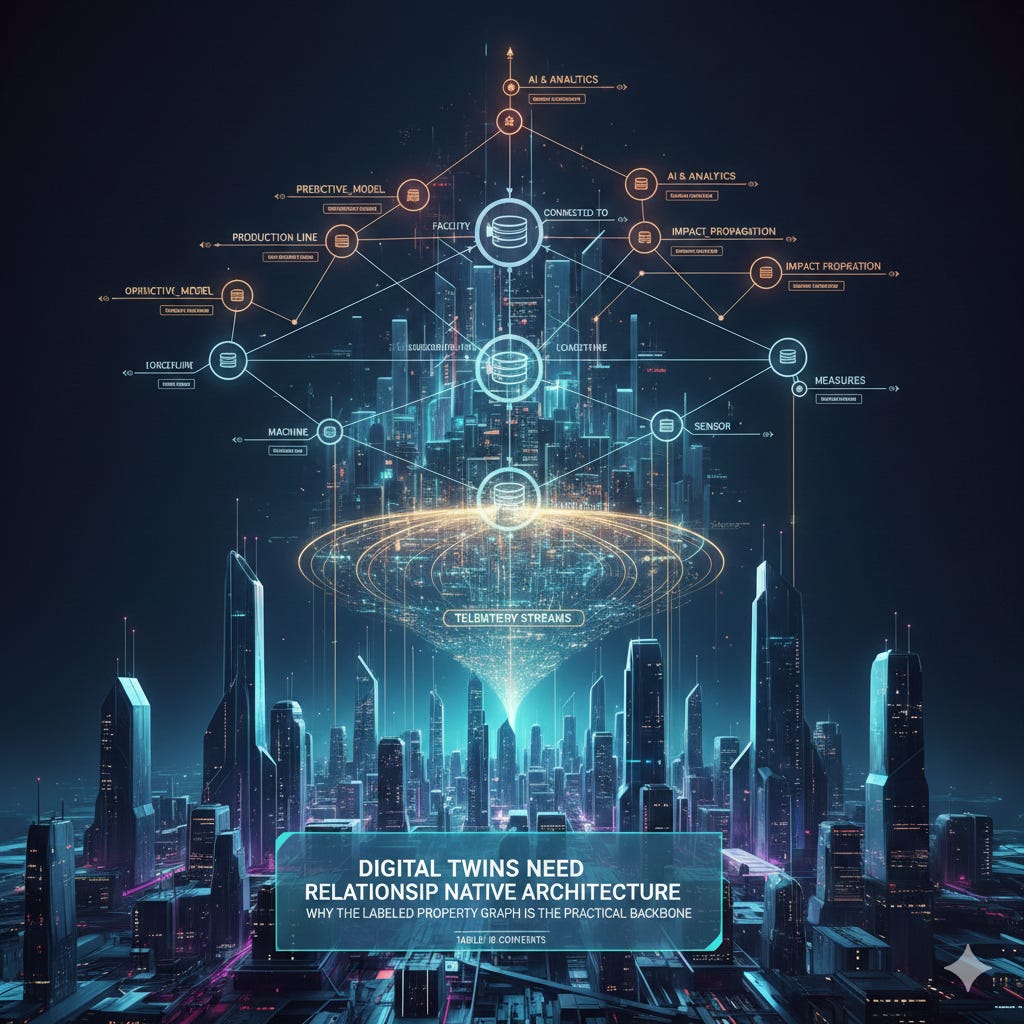
Digital Twins Need Relationship Native Architecture
Why the Labelled Property Graph Is the Practical Backbone

Table of Contents
Introduction
What a Digital Twin Actually Is
Structural Requirements of a Production Digital Twin
Why Conventional Data Models Fail
The Labelled Property Graph Model
Modelling a Digital Twin in LPG
Operational Architecture Pattern
LPG Versus RDF in Digital Twin Systems
Integration with AI and Advanced Analytics
Limitations and Boundary Conditions
Strategic Implications
Conclusion
1. Introduction
Digital Twins are widely discussed across manufacturing, energy, transport and smart infrastructure. Despite the volume of marketing material, implementation maturity remains uneven. Many initiatives deliver visualisation platforms and telemetry dashboards but struggle to evolve into true system models capable of reasoning about structure, dependency and change.
The central issue is architectural. A Digital Twin is not primarily a data collection problem. It is a modelling problem. Physical systems are networks of interdependent components. If the data model does not treat relationships as first class constructs, the twin cannot represent systemic behaviour accurately.
This article addresses the structural foundation required for production grade Digital Twins. It argues that the Labelled Property Graph model provides the most practical and scalable backbone for modelling complex physical systems in an operational context. The discussion is technical and aimed at architects, engineering leads and enterprise data strategists.
2. What a Digital Twin Actually Is
The concept of the Digital Twin emerged from lifecycle engineering, particularly within programmes associated with NASA. The initial objective was to maintain a dynamic digital counterpart of physical assets to support predictive maintenance, fault simulation and lifecycle optimisation.
Later, industry analysts such as Gartner broadened the definition to encompass digital representations of real world entities and systems across industries.
A technically rigorous understanding of a Digital Twin includes the following elements:
A structural model describing components and their topology.
A behavioural model describing how components operate under different conditions.
Continuous synchronisation with operational telemetry.
Temporal awareness of configuration and state transitions.
Contextual knowledge that captures dependencies, constraints and policies.
The structural model is foundational. Without it, behavioural and predictive layers lack contextual grounding. A Digital Twin that cannot represent and traverse dependencies between components is limited to monitoring rather than system reasoning.
3. Structural Requirements of a Production Digital Twin
Production environments involve complex, layered systems. These systems evolve continuously. Any Digital Twin architecture must therefore support a number of structural capabilities.
First, hierarchical modelling is essential. Facilities contain production lines. Production lines contain machines. Machines contain assemblies and components. The twin must represent these containment relationships explicitly and support traversal across multiple levels without performance degradation.
Second, cross cutting dependencies must be represented. A component may depend on electrical supply, network connectivity, upstream pressure or control signals. These are not attributes of a single entity. They are relationships between entities.
Third, impact propagation must be computable. If a pump fails, which downstream valves are affected. If a controller is reconfigured, which subsystems operate under new logic. The twin must support multi hop queries that reflect real world propagation paths.
Fourth, temporal validity must be modelled. Configurations change. Components are replaced. Relationships may only be valid within specific time intervals. The twin must be able to reconstruct historical topology at a given moment.
Fifth, lifecycle traceability must be maintained. Installation events, maintenance actions, inspections and upgrades must remain linked to structural elements. Historical records must not be detached from the topology in which they occurred.
These requirements are relational in nature. They demand a data model where relationships are explicit, quarriable and capable of carrying metadata.
4. Why Conventional Data Models Fail
Traditional enterprise systems rely on relational databases. While relational technology provides strong transactional integrity and structured storage, it does not naturally model deep networks of interdependency.
Recursive queries and join chains can represent relationships, but complexity grows rapidly with graph depth. Query readability declines, optimisation becomes difficult and performance becomes unpredictable under evolving workloads. Engineering change requests often require schema adjustments, which introduce operational risk.
Document databases offer flexible schemas and nested structures. They are effective for representing isolated aggregates. However, Digital Twins require reasoning across aggregates. Cross document traversal demands secondary indexing and application level logic. Denormalisation strategies can lead to duplication and inconsistency as the system evolves.
Time series databases address telemetry storage efficiently but do not model topology. Attempting to encode structural relationships in tag structures results in opaque designs that are difficult to query semantically.
Across these paradigms, the same limitation appears. Relationships are secondary constructs. They are expressed through foreign keys, embedded arrays or tag conventions. They are not primary modelling elements. As a result, reasoning about dependency and impact becomes an application responsibility rather than a data capability.
5. The Labelled Property Graph Model
The Labelled Property Graph model represents data as nodes connected by directed relationships. Both nodes and relationships can carry properties. Nodes can have one or more labels that classify their type.
Several characteristics make LPG particularly suitable for Digital Twins.
Relationships are first class citizens. They are not inferred from foreign keys. They are stored explicitly and can be indexed and traversed efficiently.
Relationships can carry properties. This allows modelling of capacity limits, validity periods, dependency strength and configuration metadata directly on the edge connecting two entities.
Traversal operations are optimised. Graph databases are designed to follow paths across multiple hops without requiring expensive join operations across large tables.
Schema evolution is flexible. New node labels or relationship types can be introduced incrementally without requiring disruptive migrations.
The LPG model therefore aligns with the way engineers conceptualise systems. Components are connected to components. Dependencies have attributes. Topology is central.
6. Modelling a Digital Twin in LPG
To illustrate the modelling approach, consider a manufacturing environment. A pump is connected to a valve. A sensor measures the pump. The pump is part of a subsystem. The subsystem is located within a facility.
In an LPG representation, each of these elements is a node with one or more labels that define its role. Relationships such as CONNECTED_TO, MEASURES, PART_OF and LOCATED_IN are explicit edges between nodes.
(:Pump)-[:CONNECTED_TO]->(:Valve)
(:Sensor)-[:MEASURES]->(:Pump)
(:Pump)-[:PART_OF]->(:Subsystem)
If the connection between the pump and the valve has attributes such as installation date, maximum pressure rating or maintenance status, these attributes are stored as properties of the CONNECTED_TO relationship.
This modelling approach offers several advantages.
First, structural clarity is maintained. The topology is readable and directly queryable.
Second, dependency metadata remains attached to the relationship itself. There is no need for additional tables or reification constructs.
Third, extensions are straightforward. Introducing a new relationship type or attribute does not require redesigning the entire schema.
Fourth, temporal modelling can be implemented by attaching validity intervals to relationships. Historical topology reconstruction becomes a matter of querying relationships with appropriate time constraints.
The result is a model that remains close to domain language and engineering reasoning.
7. Operational Architecture Pattern
A robust Digital Twin architecture typically separates functional concerns while maintaining strong integration.
Telemetry ingestion systems process streaming sensor data and store it in specialised time series infrastructure. This layer focuses on throughput, compression and temporal aggregation.
The graph layer maintains the structural model. It stores components, subsystems, facilities and their interdependencies. It links telemetry streams to structural entities through explicit relationships.
Analytics and simulation services operate across both layers. For example, a predictive maintenance algorithm retrieves recent vibration data from the time series store and queries the graph to determine upstream dependencies and downstream impact.
The graph layer acts as the contextual backbone. It answers structural questions that cannot be resolved by telemetry alone. It provides the semantic map that allows operational data to be interpreted correctly.
IoT → Stream Processor → Time-Series Store
                     ↓
               LPG Graph Layer
                     ↓
        Simulation + AI + Monitoring
Without this structural layer, advanced analytics remain isolated from system topology and risk-generating context blind insights.
8. LPG Versus RDF in Digital Twin Systems
Resource Description Framework technology provides a formal semantic foundation for knowledge representation. It supports ontology driven integration and reasoning.
However, RDF represents data as subject predicate object triples. Relationships do not natively support properties. When relationship metadata is required, reification patterns or named graphs must be introduced. This increases storage volume and query complexity.
In operational Digital Twin environments, frequent updates and deep traversal queries are common. The simplicity of native relationship properties in LPG reduces modelling overhead and improves performance for traversal intensive workloads.
RDF may be advantageous in scenarios that prioritise cross organisational knowledge sharing and formal reasoning. LPG is often better suited to operational dependency modelling where performance, clarity and ease of development are primary concerns.
The choice should be driven by workload characteristics rather than theoretical elegance.
9. Integration with AI and Advanced Analytics
Advanced Digital Twins increasingly incorporate machine learning and optimisation models. These models require context to operate effectively.
Graph structured data provides that context. Neighbourhood topology can be used to enrich feature sets. Dependency paths can explain why a predicted failure in one component affects another. Graph traversal can constrain optimisation search space to structurally feasible solutions.
Explainability is particularly important in industrial environments. When an AI model predicts a component failure, engineers require an explanation rooted in system structure. Graph based context allows tracing the dependency chain that led to the prediction.
Without relationship native modelling, AI systems operate on isolated features and risk producing results that are difficult to justify or operationalise.
An LPG backbone ensures that AI operates within the structural reality of the physical system.
10. Limitations and Boundary Conditions
It is important to recognise that LPG is not a complete Digital Twin solution in isolation.
High frequency telemetry ingestion requires time series systems optimised for write throughput and temporal aggregation.
Complex physical simulations require domain specific engines capable of modelling thermodynamics, fluid dynamics or electrical behaviour.
Formal ontology reasoning across federated domains may require semantic web technologies.
The strength of LPG lies in structural integration. It provides the coherent topology that connects specialised subsystems. It does not replace them.
An effective Digital Twin architecture is layered and modular. LPG occupies the structural core.
11. Strategic Implications
From a strategic perspective, the modelling decision has long term consequences.
Organisations that treat Digital Twins as enhanced dashboards risk stagnation. Their systems remain limited to monitoring and retrospective analysis.
Organisations that adopt relationship native modelling gain the ability to compute systemic impact, manage configuration complexity and integrate AI with structural awareness.
Over time, system complexity increases. Assets multiply. Interdependencies deepen. Without explicit relationship modelling, technical debt accumulates rapidly.
Selecting a relationship native backbone early in the programme lifecycle reduces long term architectural friction and enables gradual expansion toward system of systems modelling.
The decision is not merely technical. It shapes the organisation’s ability to evolve its Digital Twin from descriptive to predictive and eventually prescriptive capability.
12. Conclusion
Digital Twins are representations of interconnected physical systems. Their value lies in modelling structure, dependency and change over time.
The Labelled Property Graph model provides a practical and scalable foundation for this task. It supports explicit relationships, relationship metadata, efficient traversal and flexible schema evolution.
While it must coexist with telemetry stores, simulation engines and analytic platforms, LPG provides the structural coherence necessary for a true system model.
Without relationship native architecture, Digital Twins remain fragmented and limited. With it, they become robust platforms for advanced analytics, optimisation and long term lifecycle management.
Previous posts
When a Labelled Property Graph Can Legitimately Be Considered an Applied Knowledge Graph
GraphRAG and Graph Data Science for Financial Crime Document Processing
Labelled Property Graphs as a Foundation for Neuro-Symbolic Architecture
LPG, PG and RDF: Structural Models, Semantics, and Applied Reality
Why You Should Not Compare In-Memory LPG Graphs with LPG Storage Graphs
12 reasons why MCP over Applied Knowledge Graph is what you should try
Graph Summarisation Is the New Retrieval: A Practical View from the LPG and AKG Perspective
Enterprise Knowledge Graphs vs Applied Knowledge Graphs: Same Vision, Different Operational Path
A Practical Architecture for LLM Memory: LPG as the Adaptive Knowledge Cache
Labels as the Real Semantic Layer of LPG in GraphRAG and Applied Knowledge Graphs
GraphRAG Engineering Patterns: From Lexical Graphs to Knowledge Traversal
Why Large Graphs Fail Small: When LPG Scalability Breaks Cognitive Coherence
Dear Sergey,
thank you for sharing. I am trying to do just what you describe.
Did you hear about Attributed Temporal Causal Hypergraph (ATCH) framework. You can find it here: https://arxiv.org/html/2603.13603v1
Curious what you think about it.
Best regards,
B